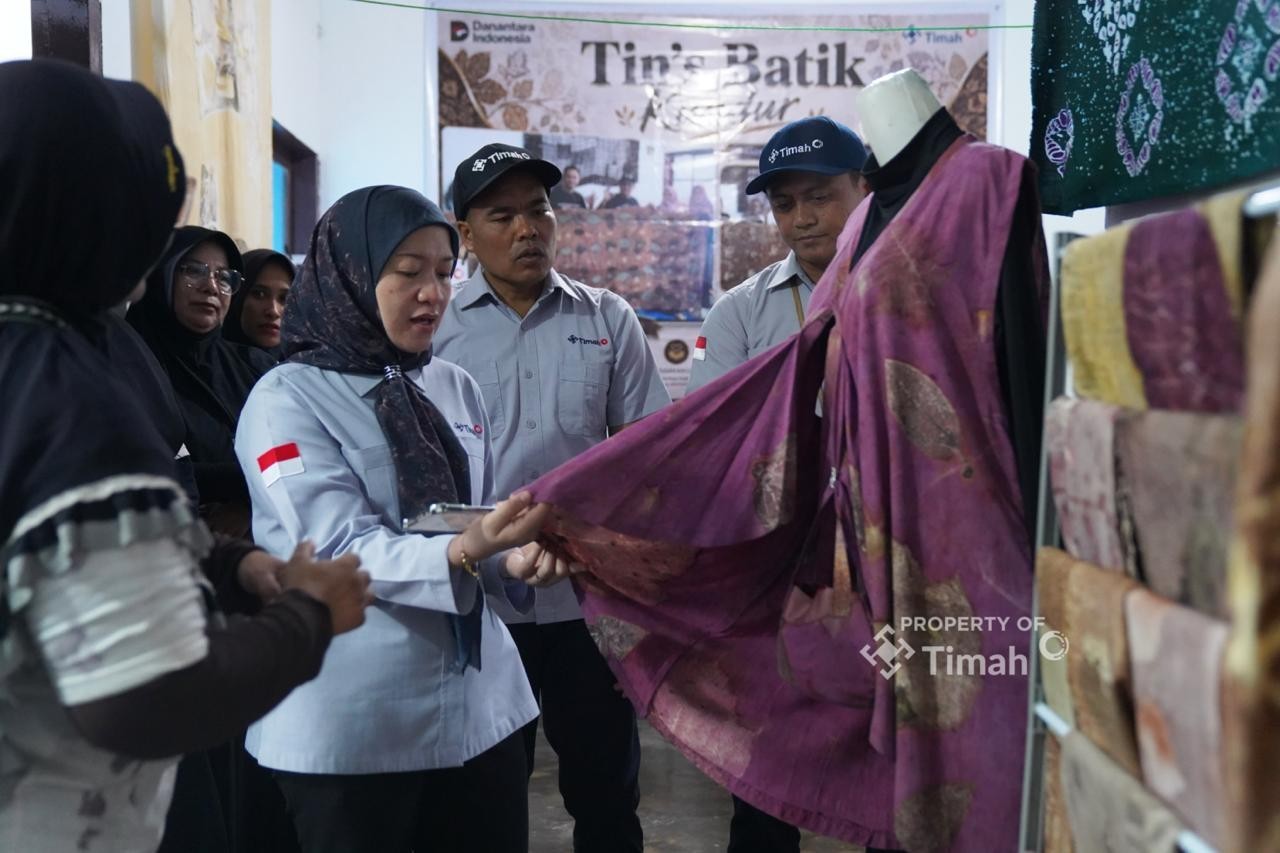
KARIMUN -- Local cultural heritage is one of the many valuable resources that communities on Kundur Island, Karimun Regency, Riau Islands Province, continue to develop. Through Rumah Batik Kundur, PT TIMAH (Persero) Tbk provides a space for local residents to learn, create, and develop distinctive batik products that reflect the region’s identity.
Rumah Batik Kundur receives support from PT TIMAH through various development initiatives, including training, the provision of batik-making facilities and equipment, and product promotion. This support has also created opportunities for local residents to learn and develop various batik-making techniques, including stamped batik, hand-drawn batik, and eco-printing.
Arman, Head of Rumah Batik Kundur, said that around 12 batik artisans are currently part of Rumah Batik Kundur, which is supported by PT TIMAH. In addition to producing batik, the artisans continue to develop their skills, particularly in the canting technique and motif development.
“We usually make batik two to three times a week. While producing our work, we also continue to learn. Thankfully, the women are truly committed to creating and improving their craft,” Arman said.
Rumah Batik Kundur develops motifs inspired by the natural resources and local identity of Kundur Island and Karimun Regency. These include motifs featuring kundur flowers, female and male snails, shrimp, grouper fish, sago trees, and jong, one of the region’s cultural symbols.
Developing local motifs is an important part of establishing the distinctive identity of Kundur batik. The products are also being expanded beyond batik fabric into clothing and bags, with plans to develop a wider range of accessories in the future.
Arman explained that Rumah Batik Kundur is still in the development stage. The artisans continue to face several challenges, particularly in mastering the canting technique.
“With eco-printing, one of the challenges is determining the right colors so they complement each other and ensuring that the impressions left on the fabric come out clearly,” he explained.
For this reason, training plays an important role in strengthening the artisans’ skills and capabilities. PT TIMAH has previously provided eco-printing training and introduced other techniques, including stamped batik and painted batik.
In addition to training, PT TIMAH has supported Rumah Batik Kundur by providing various production materials and equipment, including fabric, canting tools, and other batik-making supplies.
“PT TIMAH’s support has been very helpful to Rumah Batik Kundur. PT TIMAH has provided various materials and equipment we need for batik making, including canting tools and fabric. We have also received eco-printing training,” Arman said.
He hopes the support will continue to encourage the artisans to strengthen their skills and create an increasingly diverse range of products.
“We are grateful that PT TIMAH supports Rumah Batik Kundur. Now it is up to us as artisans to continue developing our skills and creating new works,” he said.
In addition to improving production capabilities, marketing remains another challenge for Rumah Batik Kundur. As a group that is still growing, Kundur batik products are not yet widely known outside the Kundur area.
Therefore, promotional support and opportunities to participate in exhibitions provide important platforms for the artisans to introduce their work to a broader audience.
Arman said that some time ago, PT TIMAH facilitated Rumah Batik Kundur’s participation in an exhibition in Tanjung Balai Karimun, providing an opportunity for the group to showcase and promote its various products.
“We hope this local batik will become better known throughout Indonesia. We want to continue creating so that our work can also generate economic benefits for the artisans,” he said.
According to Arman, as the artisans further develop their batik-making skills and improve product quality, opportunities to reach broader markets will also continue to grow.
Rumah Batik Kundur continues to move forward in its development. The women artisans are not only learning to produce beautifully patterned fabrics, but are also building skills, fostering creativity, and creating business opportunities rooted in the cultural richness of their surroundings. (*)