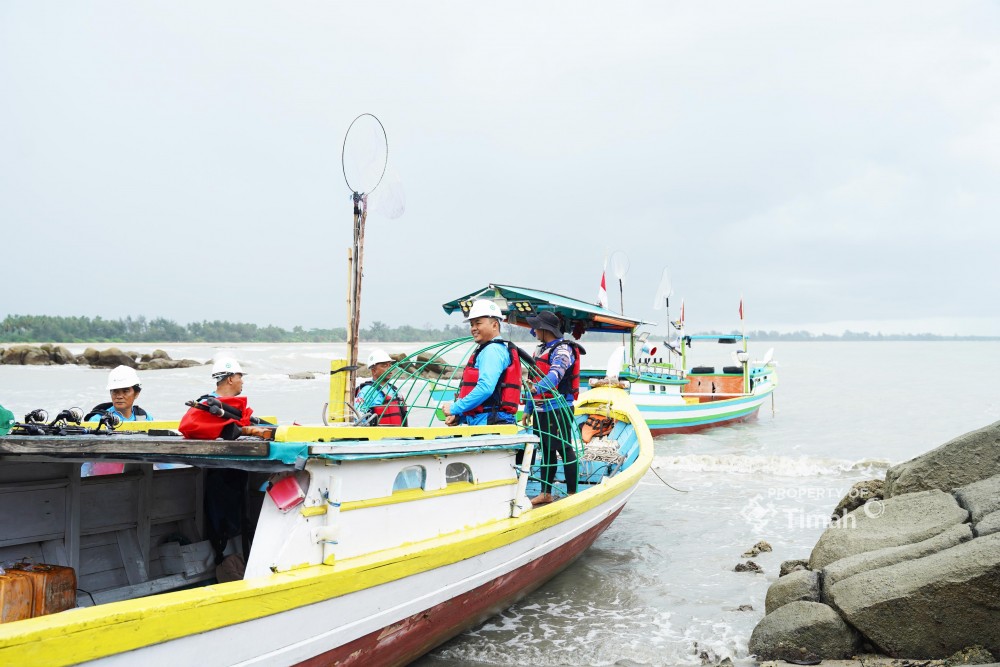
PANGKALPINANG -- The ocean is one of the Earth’s most vital ecosystems, providing natural resources, regulating the global climate, and serving as home to diverse marine life. In response, PT Timah is committed to marine conservation efforts.
PT Timah's marine environmental conservation efforts are carried out continuously and form part of the company’s reclamation program. The marine reclamation program is implemented in the Bangka Belitung Islands Province and the Riau Islands Province.
PT Timah’s marine reclamation initiatives include the sinking of artificial reefs, mangrove planting, restocking of squid and mangrove crabs, monitoring seawater quality, and installing coastal abrasion barriers.
From 2016 to 2024, PT Timah, a member of the MIND ID Mining Industry Holding, has deployed 1,475 units of coral transplants, 3,105 fish shelters, 7,680 artificial reefs, and restocked 40,435 squid in the Bangka Belitung region.
Meanwhile, in the Riau Islands Province, reclamation efforts from 2017 to 2024 include installing 2,360 meters of abrasion barriers, planting 12.81 hectares of mangroves, and restocking 3,800 mangrove crabs.
In carrying out its marine reclamation efforts, PT Timah also collaborates with fishermen’s groups, the Sayang Babel Kite Foundation, local governments, and POSSI Bangka Belitung (Indonesian Diving Association).
Chairman of the Sayang Babel Kite Foundation, Indra Ambalika Syari, stated that they have been working with PT Timah since 2017 on marine reclamation projects, including coral transplants, coral gardens, fish shelters, squid attractors, squid restocking, coral reef monitoring, mangrove planting, and marine biota conservation around Bangka Island.
"The marine reclamation program carried out by PT Timah was the first of its kind implemented in Indonesia. This initiative proves that marine reclamation should become a standard obligation in the mining industry. It has become a valuable learning model to be applied on a national scale," said Indra, a Marine Science Lecturer at Bangka Belitung University.
According to him, mining activities, even if land-based, can impact marine water quality and marine life, and therefore must include marine reclamation efforts as part of the environmental responsibility to protect the ocean ecosystem.
Indra explained that the artificial reefs deployed by PT Timah have proven to serve as new habitats for marine life in the placement areas. These sites have become new fishing grounds for local fishers and have potential to be developed for diving and recreational fishing tourism.
"PT Timah has actively engaged in marine ecosystem restoration through its marine reclamation programs. Overall, these efforts have added value to marine ecosystems and made them more beneficial to local communities," he said.
He added that based on monitoring results, the deployment of artificial reefs, coral gardens, fish shelters, squid attractors, and fish aggregating devices (rumpon) have strong potential to be developed into marine tourism and fisheries areas.
The benefits of PT Timah’s marine reclamation program are also being felt directly by local fishers, such as Rispandi, a fisherman from Tanjung Kubu Village in South Bangka Regency.
Rispandi shared that the presence of artificial reefs in the waters of Tanjung Kubu has significantly improved their fish catches. Moreover, they no longer need to travel far out to sea.
“There are so many benefits we’ve felt from the fish shelters here in Tanjung Kubu. We don’t have to go far offshore anymore because the fish are gathering around the shelters. The spot is not too far from the beach, and we get bites quickly,” he said.
“In the past, we’d head out before dawn and return in the evening with only about 10 kg of catch. Now, we can bring home up to 50 kg in a day. And it’s premium fish — seminyak, jarang gigi, red snapper — and right now it’s squid season, so at night, there’s plenty of squid around the shelters,” he added.
PT Timah’s Department Head of Corporate Communication, Anggi Siahaan, stated that the marine reclamation program not only helps preserve marine ecosystems and mitigate ecological impacts, but also delivers economic benefits to the surrounding communities.
"The marine reclamation program is a proactive initiative by the company to preserve marine ecosystems. It is carried out sustainably and is expected to deliver both ecological and socio-economic benefits. In the future, the artificial reefs are also expected to support the development of underwater tourism," Anggi said.