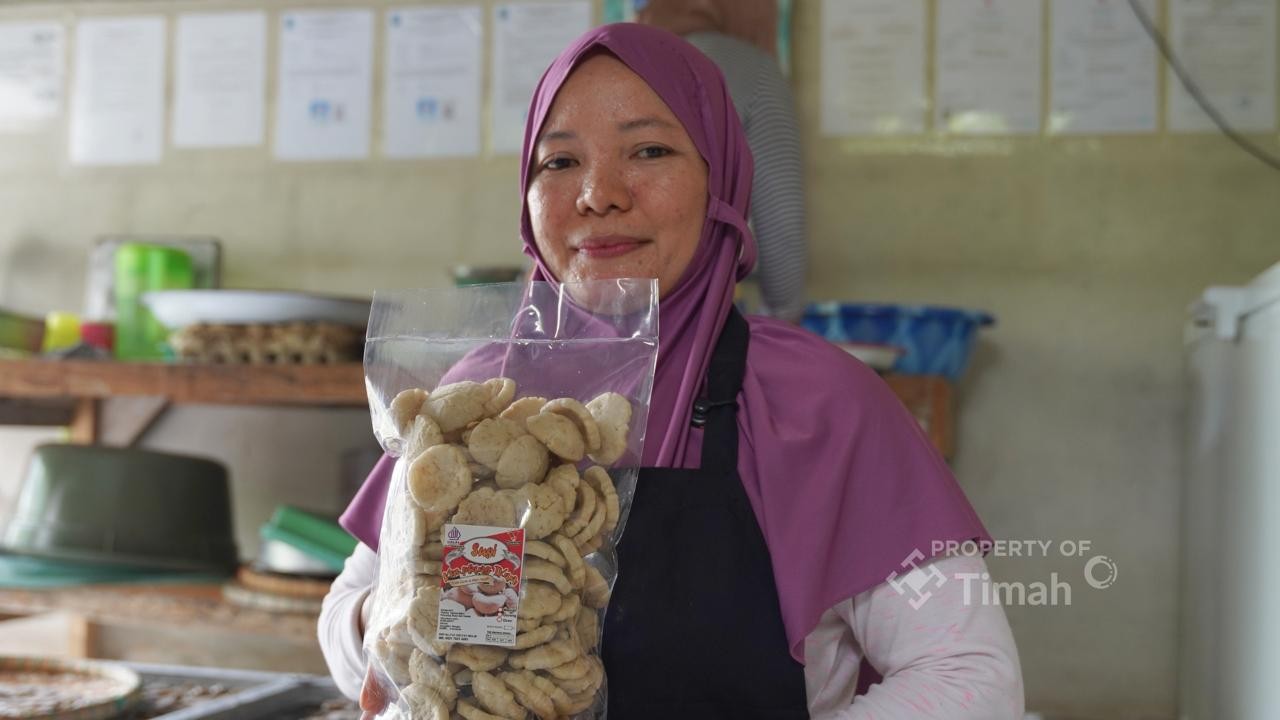
BANGKA -- Susilawati skillfully kneads the dough for her jengkol crackers at her production facility in Parit Padang Subdistrict, Sungailiat District, Bangka Regency. Assisted by one of her employees, she transforms jengkol, or dogfruit, into a savory snack with a distinctive flavor.
Once thoroughly mixed, the dough is shaped and steamed. This is one of the essential stages before the crackers are sliced, sun-dried, fried, and packaged.
Behind this simple production process lies the story of a woman's perseverance in building a business while developing the potential of local food products.
Under the Kemplang Susi brand, Susilawati not only produces traditional fish crackers, which were her original product, but also continues to innovate by introducing various products, including jengkol crackers, corn chips, and ampiang, a traditional snack.
She started her business in 2017. Initially, Susilawati made fish crackers solely for her family's consumption. However, after people around her tasted the crackers and responded positively, many expressed interest in purchasing them. This encouraged her to turn her skills into a business opportunity.
Drawing on five years of experience working at another cracker-making business, Susilawati gradually established her own enterprise. Starting with an initial production volume of approximately three kilograms, she has since increased her production capacity to around 10 kilograms per batch.
Innovation has become one of Susilawati's strategies for sustaining her business. In 2025, she began developing jengkol-based crackers. The idea emerged from her own fondness for jengkol and the popularity of its distinctive flavor among those around her.
Processing jengkol into crackers requires considerable patience and attention to detail. After peeling, the thin outer skin must be removed before the jengkol is boiled, ground, and mixed with other ingredients. Susilawati also uses her own techniques to achieve a flavor and texture that appeal to consumers.
“Another challenge we faced was the availability of jengkol as a raw material. We used to buy it at the market, but now we source it directly from farmers, which means we need a freezer,” she said.
For her fish crackers, Susilawati uses laisi and tamban fish sourced directly from the harbor. The fish are processed while still fresh to preserve their natural flavor.
“When we process the fish immediately, its natural flavor is more pronounced, with a slightly sweet taste. We do not add sugar because the sweetness comes naturally from the fresh fish,” Susilawati explained.
In running her business, Susilawati also pays close attention to the quality of every product. The dough is shaped into cylindrical rolls, steamed, and then sun-dried. The drying process typically takes nearly two days when the weather is clear and sunlight remains consistent.
Although she has a drying oven to accommodate unfavorable weather conditions, she continues to rely on sunlight because she believes it produces better results. For Susilawati, maintaining product quality is a top priority in preserving customer trust in Kemplang Susi.
Today, Kemplang Susi products are marketed through a network of resellers in Pangkalpinang, Sungailiat, and several other areas. Ahead of Eid al-Fitr, the number of resellers distributing her products can reach approximately 30.
Susilawati's journey in developing her business has also received support through the Micro and Small Enterprise Funding (PUMK) program of PT TIMAH (Persero) Tbk. She has been a business development partner of the company since 2024 and has continued to grow her business.
The funding has been used to purchase a chest freezer to maintain an adequate supply of jengkol, acquire additional steaming equipment, and meet production needs for raw materials and packaging.
For Susilawati, the financial support has provided tangible benefits for her business development. She is now better equipped to maintain inventories of both raw materials and finished products, particularly during periods of increased demand, such as Ramadan and Eid al-Fitr.
“Alhamdulillah, we have truly experienced the benefits. Our revenue has increased, and we are also able to build up our product inventory. Our partnership with PT TIMAH has been very helpful to our business,” she said.
Beyond financial assistance, Susilawati has also participated in exhibitions and bazaars to introduce her products to a broader market. She has received training and business development guidance as part of efforts to strengthen the capabilities of micro, small, and medium enterprises (MSMEs).
Amid rising raw material costs and fluctuating sales, Susilawati remains committed to maintaining product quality without compromising flavor.
For her, the business she has built over the years is more than just a source of income. It is also an opportunity to continue growing and improve her family's well-being.
She hopes PT TIMAH will continue to grow and expand its support for MSMEs that need guidance and assistance in developing their businesses.
“I hope PT TIMAH continues to achieve greater success and prosperity while continuing to support MSMEs that genuinely need assistance,” she said. (*)