BANGKA -- Whoever truly loves nature will never build monuments. Life is lived only to meet one’s needs, never in excess, because living in harmony with nature is far more important. Karl Polanyi, one of the greatest economic thinkers of the 20th century, described such a way of life as a subsistence socio-economic system.
In Bangka Belitung, culture began with footsteps planted in the fields, hands weaving fishing rods and hooks, or bodies immersed in mud. Anthropologists from the colonial era to the contemporary period categorized the people of Bangka Belitung into three major groups: hill people, inland people, and sea people. Each group had its own mode of production.
Such cultural expressions are reflected in the proverb, “tamarind from the mountains, salt from the sea, meeting in one pot.” There is tamarind, there is salt—everything is divided; people are grouped into different units of labor. Some communities produce tamarind in the highlands, while others produce salt along the coast—they meet to trade; salt exchanged for tamarind, fish exchanged for spices. That complex social structure and system became the origin of the “pot,” what we now call the Bangka Belitung Islands.
Anthony Giddens, in his book The Consequences of Modernity, assumed that modernism is like an uncontrollable juggernaut crushing everything in its path. People are forced into uniformity through the same medium of exchange, through money, through labels of what is considered modern and what is not.
Modes of economic production changed, social standards shifted, and cultural values became commodified. Yet we know that in every great wave of change, there are always elements that endure.
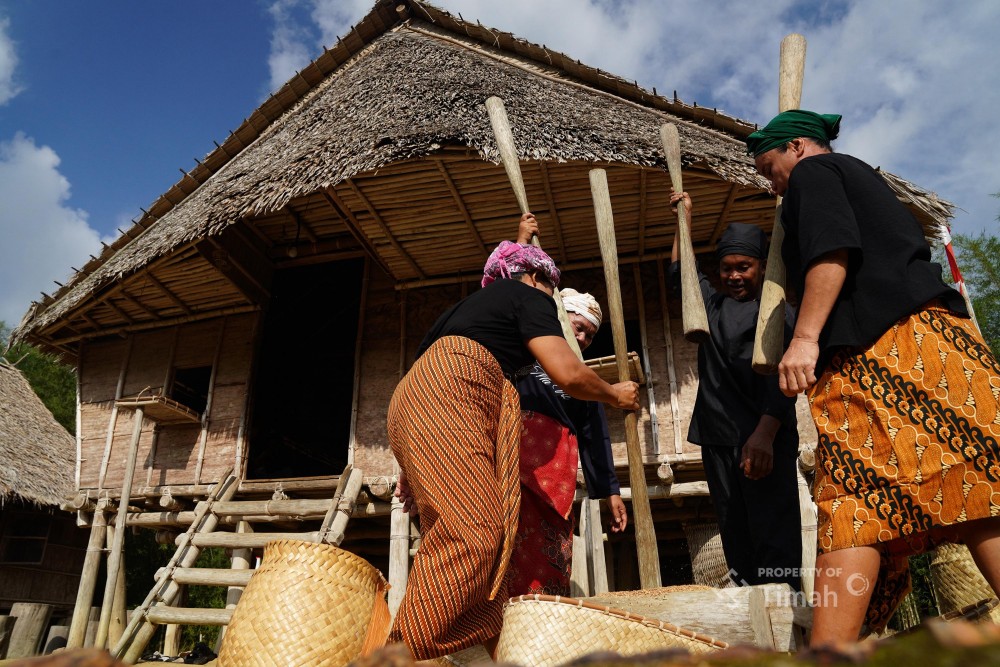
“All of us here will continue protecting nature, protecting the forests that are being eroded day by day,” said Asih, Head of the Mapur Traditional Institution, during the Nujuh Jerami traditional ritual at Gebong Memarong Indigenous Village, Air Abik Hamlet, Gunung Muda Village, Bangka Regency, on April 29, 2026.
In reality, according to expedition records from 1803 by a Dutch colonial explorer named Boogart, they were already there. The world changed, the Dutch East Indies returned to a barren Europe, Indonesia Raya echoed across the nation, regimes changed, and they remained there. But for how long?
“Until our last breath, brother!” said Jojo, one of the followers of Mapur tradition who enjoys joking and is always smiling warmly.
Jojo explained that besides the approximately 100 people living in Air Abik Hamlet, there are around 150 of their relatives who still live nomadically in the Pejem Forest.
“They, like us, also go to school. Some even attend college. We often meet them whenever there is something to exchange,” Jojo shared.
Culture is never constant or eternal; it is always shaped and reshaped through adaptation. Charles Darwin, in The Origin of Species, never stated that the strongest survive, contrary to the popular slogan “the survival of the fittest.” According to Darwin, it is not the strongest who survive, but those most capable of adapting to cosmic change who endure to the end.
“We have performed the Nujuh Jerami ritual since the time of our grandparents. Maybe even longer than that. The difference is that since 2017, after receiving support from PT TIMAH, more people have come to see it and ask questions. Now it is livelier because there are loudspeakers, photography, and visitors from outside who come to watch,” he said.
Today, there is a growing tendency among modern 21st-century society to view customs and traditions merely as a form of high culture that begins and ends in coffee shops, gallery displays, seminar rooms, and academic papers. Culture becomes something entertaining to watch and discuss, rather than something truly lived.
Whether we like it or not, the wisest way to preserve culture is by walking alongside indigenous communities. PT TIMAH has done exactly that, repeatedly, for a long time.
As Jojo explained, the Nujuh Jerami ritual became more widely known after receiving support from PT TIMAH. Yet what is being preserved is not merely a ceremony, but the living collective memory within it—the traces of history, values, and the indigenous community’s worldview toward nature and life.
That effort first took shape through the book Mapur Mendulang Kisah Meraup Berkah. PT TIMAH not only supported the writing process, but also brought the stories of the Mapur Indigenous community into schools. From classrooms, stories once passed down orally have now become cultural literacy materials, allowing younger generations to recognize the roots that shaped them.
The initiative then evolved into a more tangible effort to preserve tradition through the establishment of Gebong Memarong Indigenous Village, a cultural learning space showcasing the traditional homes of the Mapur Indigenous people. For the Mapur community, a memarong is not merely a building; it is a home, a place where memories reside, and where traditions are passed down from one generation to the next.
Memarong houses are built from selected wood tightly bound with strips of rattan, without a single nail. Their floors are made of split ibul or nibung wood woven together with rattan. The walls come from tree bark, while the roofs are covered with nipa or thatched palm leaves. Every part of the memarong contains ancient knowledge about how humans can live harmoniously with nature—taking only what is necessary and returning it with respect.
Seeing the growing potential, PT TIMAH did not stop at symbolic preservation. The company also prepared the indigenous community so that life in Gebong Memarong Indigenous Village would continue to thrive and provide real benefits. Batik-making training was organized, weaving equipment was provided, residents were trained as tour guides, and the area was introduced to company guests.
Today, Gebong Memarong Indigenous Village is not only a guardian of tradition. It has grown into a living space that provides economic benefits for the community, while also becoming a place of learning for thousands of students who come to trace the footsteps of history. There, the past is not allowed to fade into silence. It continues to live on, and PT TIMAH has long walked alongside that effort, faithfully accompanying the small yet meaningful steps that keep this heritage breathing to this day. (*)