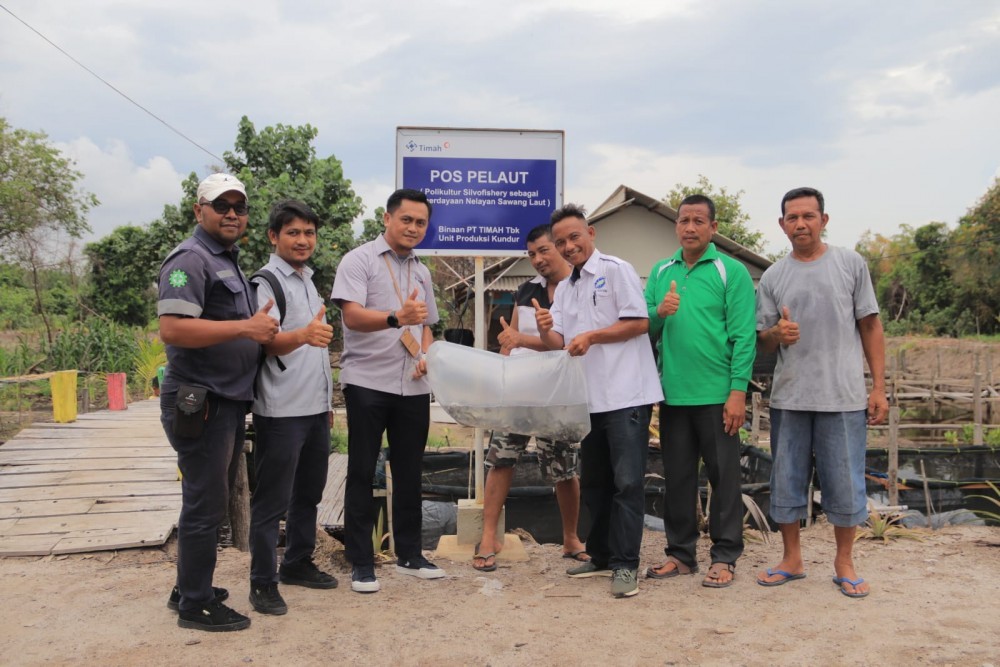
KARIMUN -- PT TIMAH (Persero) Tbk continues to promote economic independence among communities in its operational areas. Through various sustainable community empowerment programs, the company supports residents of Sawang Laut Village, West Kundur District, Karimun Regency, Riau Islands Province, in developing local potential and creating new economic opportunities.
Over the past several years, PT TIMAH has implemented a range of programs tailored to the needs of the Sawang Laut Village community. These initiatives include economic empowerment, social and religious support, and assistance in meeting residents' basic needs.
Sawang Laut Village Head Jefrizal said PT TIMAH's presence has helped the village address several community needs, including access to clean water during the dry season. Residents of Hamlet I, particularly Neighborhood Units RT 03 and RT 04, frequently experience water shortages during periods of drought.
"During the dry season, residents of Hamlet I, especially RT 03 and RT 04, really struggle to access water. For their daily needs, they rely on drilled wells provided through government programs," Jefrizal said.
According to Jefrizal, PT TIMAH's support goes beyond addressing immediate needs and also focuses on creating economic opportunities through sustainable community empowerment initiatives.
Programs implemented in Sawang Laut Village include Asian seabass farming by the Tuah Bersatu Fish Farmers Group (Pokdakan), the development of laying hen businesses, shrimp paste production, hydroponic farming, and a waste bank initiative established in 2025.

PT TIMAH also supports community social and religious activities, as well as the development of landmarks that reflect the village's identity, such as the Simpang Tanjak Monument. The company has also supported religious events, including the Musabaqah Tilawatil Quran (MTQ), a Quran recitation competition.
Jefrizal believes these programs have begun to deliver tangible benefits to the community. Local groups have gained opportunities to learn, develop new skills, and make better use of the resources available in their surroundings.
For example, produce from the hydroponic farming program has been used to meet household food needs. Meanwhile, the Asian seabass farming group and shrimp paste producers have gained knowledge and practical experience that can serve as a foundation for expanding their businesses.
"Thank God, the community is beginning to experience the benefits. Residents are gaining new knowledge and skills. At the very least, these activities can become additional sources of income and have a positive impact on the community," he said.
Jefrizal hopes the collaboration with PT TIMAH will continue, allowing community empowerment programs to become increasingly aligned with residents' needs and contribute to the village's economic independence.
In addition to economic empowerment, he hopes PT TIMAH will expand its support for education, particularly by providing scholarships for children from low-income families to pursue higher education.
He believes access to higher education can create opportunities for the village's younger generation to build a better future while bringing pride to their families and communities.
"We hope there will be scholarship programs for children from low-income families, especially to help them continue their education through college. We want children in our village to have the same opportunities to pursue higher education," he said.
The Lanjut Lestari Women's Farmers Group (KWT), which processes small shrimp known locally as rebon into shrimp paste under the brand name "Belacan Cinta," has also experienced the benefits of PT TIMAH's community empowerment initiatives.
Susilawati, head of the Lanjut Lestari Women's Farmers Group, explained that the group was established with support from PT TIMAH. The group is also mentored by the Tuah Bersatu Fish Farmers Group, which is itself supported by PT TIMAH.
Susilawati said PT TIMAH's empowerment programs have brought significant changes to her group, particularly in creating economic opportunities for women.
"Thank God, we have received tremendous support. At first, we didn't know how to make shrimp paste, but after receiving training, we can now produce it ourselves," she said recently.
She explained that the abundance of rebon shrimp in their area presented an opportunity to develop a sustainable product with economic value. Previously, locally caught rebon shrimp had not been fully utilized or processed into higher-value products.
"Our area has an abundant supply of rebon shrimp. Recognizing this potential, PT TIMAH and the fish farmers group helped train us to process it into shrimp paste. Now we have a product that we can sell," she said.
In addition to providing training, PT TIMAH has supported the group's production facilities and equipment, including the construction of a production facility and the provision of tools and machinery for shrimp paste processing.
"PT TIMAH has provided tremendous support, from production equipment and machinery to building a production facility for us. We have truly received comprehensive support," Susilawati said. (*)