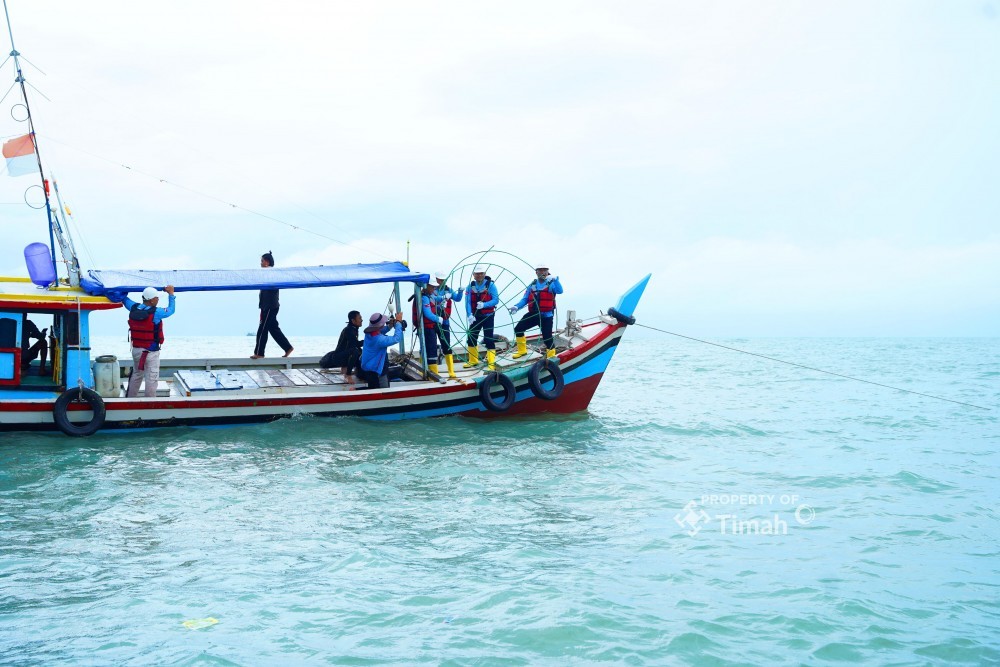
PANGKALPINANG -- Marine reclamation has become one of the key efforts in preserving and restoring aquatic ecosystems. Through its marine reclamation program, PT TIMAH Tbk has implemented various environmental recovery measures to restore the ecological functions of coastal waters and support the sustainability of coastal areas.
PT TIMAH Tbk carries out marine reclamation through several initiatives, one of which is the deployment of artificial reefs. These structures serve as new habitats for marine life, providing shelter, feeding grounds, and breeding areas, thereby forming new ecosystems on the seafloor.
In 2025, PT TIMAH Tbk deployed a total of 1,920 artificial reef units across the Bangka Belitung Islands Province as part of its efforts to create new habitats for marine organisms and preserve marine ecosystems.
The artificial reef deployment program was carried out in 11 marine locations across Bangka Regency, West Bangka Regency, Central Bangka Regency, and South Bangka Regency.
The deployment sites include the waters of Rambak, Rebo, Tuing, Lampu Island, Tanjung Melala, Malang Gantang, Tanjung Ular, Karang Aji, Pelepas Island, Panjang Island, and Kubu Waters. The reef structures are dome-shaped, resembling food covers.
Indra Ambalika Syari, a marine science lecturer at the University of Bangka Belitung, explained that the presence of these artificial reefs has had a positive impact on the marine ecosystem. Areas that were previously sandy seabeds have now developed into new habitats naturally colonized by various marine plants and animals.
“At the artificial reef sites, many marine organisms are now gathering, feeding, spawning, attaching their eggs, and growing. From an ecological perspective, these artificial reefs are specifically designed to create new habitats for marine life on the seafloor,” Indra said on Monday (February 10, 2026).
Beyond ecological benefits, PT TIMAH Tbk’s marine reclamation program also emphasizes local community empowerment. The construction of the artificial reef frames involves local residents, transportation is carried out using local fishermen’s boats, and the deployment process employs workers from surrounding communities.
“Directly, this program provides economic value to the community. In addition, the newly formed habitats also become new fishing grounds for fishermen,” Indra added.
Based on monitoring results, measurements of edible fish biomass at the artificial reef sites have shown significant outcomes.
“The biomass of fish commonly consumed by the community has reached more than 600 kilograms per hectare in the new artificial reef locations,” he noted.
Indra emphasized that the marine reclamation program carried out by PT TIMAH Tbk reflects the company’s environmental responsibility for its offshore mining activities. However, he added that the program should continue to be evaluated and improved to ensure more sustainable benefits for both the environment and the community.
“This program should serve as a trigger and a role model for other companies, especially those in the tin mining industry, to take responsibility for the environmental impacts on marine ecosystems,” he said.
Through its marine reclamation efforts, PT TIMAH Tbk reaffirms its environmental responsibility as part of the company’s sustainability principles. The program is expected to provide long-term benefits for marine ecosystems and coastal communities.