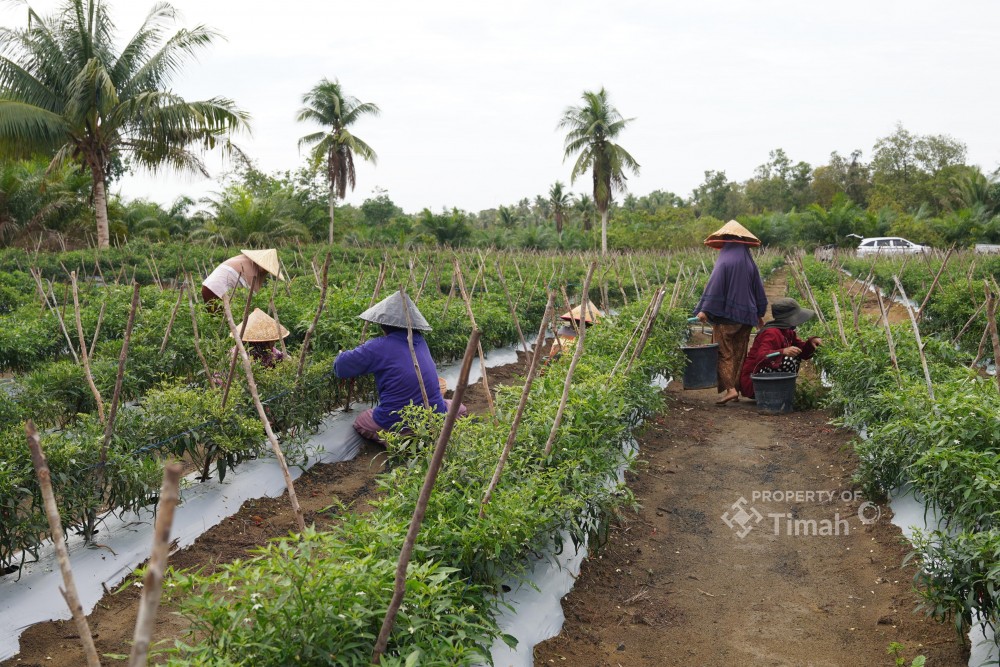
BANGKA -- Rows of lush green chili plants stretch across Batu Ampar Hamlet, Kenanga Village, Bangka Regency. Among the dense foliage, curly chili peppers hang from the plants. Some are still green, while others have begun turning red, indicating that they are ready to be harvested.
On Thursday morning, November 19, 2026, around seven women were busy making their way through the rows of plants. Each carried a bucket to collect the chili peppers they picked one by one. From time to time, they bent down to select ripe peppers before placing them into their containers.
The harvest created a distinctive scene on the farm owned by Indarto, a 42-year-old farmer affectionately known as Darto. On this land, he began developing chili cultivation as a new source of income after previously focusing on growing watermelons and melons.
Indarto’s journey in building his agricultural business did not happen overnight. Before owning his own farms, he started his business as a fruit supplier in 2004. At the time, he sourced watermelons and melons from Lampung to sell in Bangka.
Recognizing promising market opportunities, Indarto decided to venture into fruit cultivation independently. In 2019, with financial support from PT TIMAH (Persero) Tbk through its Micro and Small Enterprise Funding (PUMK) program, he began developing a watermelon farm.
Having started as a fruit supplier, Indarto eventually established his own watermelon farm. His business continued to grow, and in 2024, he further diversified his agricultural commodities by developing melon farms.
Determined to keep expanding, Indarto identified another business opportunity. This time, he chose to cultivate curly chili peppers and bird’s eye chili peppers in Batu Ampar Hamlet.
This marks his third chili growing cycle. On the farm, he planted approximately 15,000 curly chili plants and 1,000 bird’s eye chili plants. After a growing period of approximately three months, the chili plants have now entered the harvesting stage.
During a single growing cycle, chili peppers can be harvested more than 30 times over a period of six to seven months. In the early stages, each harvest yields approximately 100 kilograms. During the peak harvesting season, however, production can reach around 500 kilograms per harvest.
For the current growing cycle, Indarto aims to produce up to 15 metric tons of chili peppers. Current market prices are also promising, ranging from IDR 65,000 to IDR 70,000 per kilogram.
For Indarto, cultivating a variety of agricultural commodities is a way to respond to market demand while maintaining business sustainability. He also carefully schedules planting periods to ensure that his produce is available when supplies from outside the region decline, particularly during the rainy season.
“The financial support from PT TIMAH has enabled me to continue growing my business and identify market opportunities. I used to source fruit from outside the region, particularly Lampung, to sell here. Now, I have my own watermelon and melon farms, and I have also started developing my chili farming business,” he said.
Indarto currently manages farms in four different locations: a chili farm in Batu Ampar Hamlet, melon farms in Kenanga Village and Sungailiat, and a watermelon farm in the Jelitik area.
To manage all his farms, he employs approximately 10 permanent workers. This number increases to anywhere from a dozen to several dozen workers during harvesting periods. Most of the workers are local residents.
His agricultural products are sold not only in Bangka Regency but also distributed to several other areas, including Pangkalpinang, South Bangka, Central Bangka, and West Bangka.
Indarto’s business journey has not always been smooth. He once suffered significant financial losses when his watermelon crops failed. However, the experience did not discourage him. Instead, he continued learning and exploring new opportunities to develop his business.
“Alhamdulillah, the benefits have been significant. Through this business, I have been able to improve my family’s welfare. I have even been able to purchase a house and a vehicle with the income from farming. I am grateful that a business that started small has now grown,” he said.
One local resident who has benefited from Indarto’s business is Jamilah, 55. The mother of three expressed her gratitude for the opportunity to work as a chili picker. She had previously done similar work harvesting bird’s eye chili peppers.
“Alhamdulillah, I am grateful for this opportunity to harvest chili peppers. It has helped me financially and enabled me to meet my daily needs,” she said.
Working under a daily wage system, Jamilah is pleased to have an occupation while earning an income. For her, employment opportunities like this are something to be grateful for, as they help support her family’s financial needs.
Mardiana shared similar sentiments. She said she was happy to take part in the chili harvest because the income she earns helps meet her family’s financial needs.
For Jamilah, Mardiana, and other women in Tanjung Ratu Village, the opportunity to work on the chili farm offers more than just daily wages. It brings a sense of gratitude, togetherness, and hope for strengthening their families’ financial well-being through their work.
Indarto’s story illustrates how access to capital can create opportunities for microenterprise owners to grow and develop their potential. Support through PT TIMAH’s PUMK program not only helps businesses maintain their working capital but also encourages the growth of productive economic activities within local communities.
Through its support for micro, small, and medium enterprises (MSMEs) and the agricultural sector, PT TIMAH continues to deliver broader economic benefits to communities in its operational areas. For Indarto, his flourishing farms are more than just places to plant and harvest crops; they are also spaces where he can nurture hope and build a better future for his family. (*)