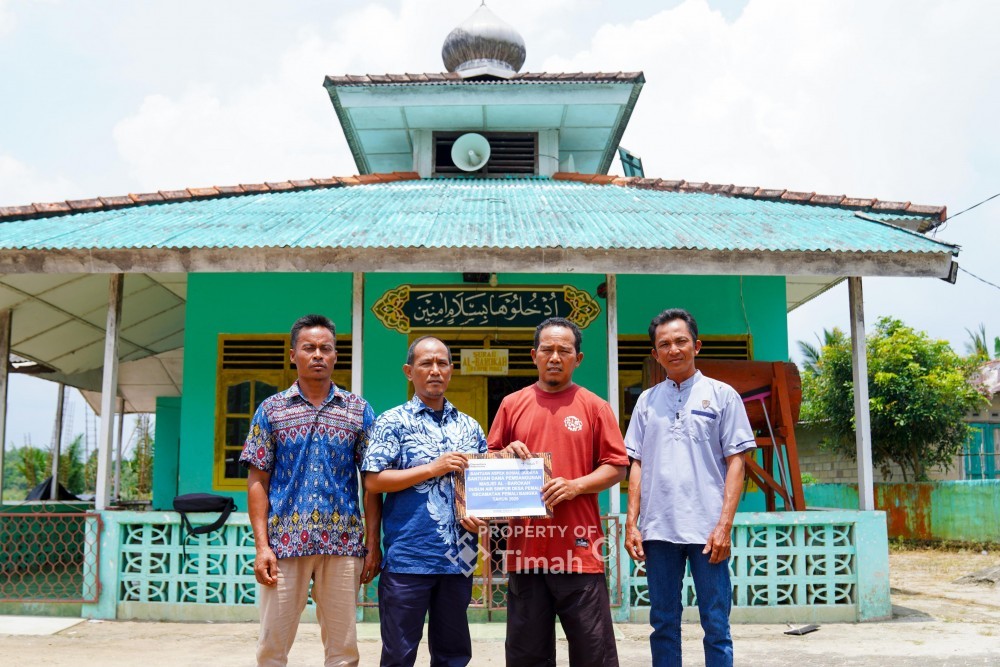
PANGKALPINANG -- Supporting the social and religious life of communities continues to be part of PT TIMAH (Persero) Tbk’s commitment. As of the first half of 2026, PT TIMAH has provided support to 27 houses of worship across the company’s operational areas.
The support has been provided in the form of assistance for construction as well as improvements to facilities and infrastructure at houses of worship. This assistance is part of PT TIMAH’s Social and Environmental Responsibility (TJSL) program to support religious activities and community social life.
One example is the company’s support for the development of facilities and infrastructure at Al Ikhlas Prayer Room in Daya Baru IV Hamlet, Mentok, West Bangka Regency.
Suryan, Head of Facilities and Infrastructure Procurement for Al Ikhlas Prayer Room, said several facilities still need to be completed, including restrooms, flooring, a sound system, a garage, fans, and prayer rugs for worshippers.
According to him, PT TIMAH’s assistance will be prioritized for purchasing materials to construct restrooms at the prayer room. The facility is urgently needed because worshippers currently have to return home when they need to use a restroom.
“Restrooms are a priority. We will use PT TIMAH’s assistance to purchase materials for restroom construction. Until now, worshippers have had to return home because the facility was not available,” he said.
PT TIMAH has also provided similar support for the construction of a prayer house for the Wesley Post Congregation of the Indonesian Methodist Church (GMI) in Karimun Regency, Riau Islands.
Located on Gang Sahata, Sukamaju Village, Sungai Pasir Subdistrict, Karimun Regency, the prayer house is a facility that the congregation has long awaited. For approximately three years, the Wesley Post congregation has been using a rented facility to hold various religious activities.
Vebrian Amos B. Sinaga, Head of the Construction Committee for the GMI Wesley Post Congregation Prayer House in Karimun Regency, said limited funding has been one of the challenges in constructing the facility.
“In addition to assistance from PT TIMAH, we have also raised funds through bazaars and contributions from congregation members. We are very grateful because this assistance is significant and has greatly supported the construction of the prayer house,” he said.
Once completed, the prayer house will be used not only for regular worship services but also for various ministry activities, children’s development programs, education, social activities, and arts and music education.
“The congregation, which has long hoped for a prayer house, feels blessed and joyful. Thanks to PT TIMAH’s assistance, construction of the prayer house can progress more quickly,” Ramsida said.
Meanwhile, in East Belitung Regency, PT TIMAH provided support to improve the facilities and infrastructure of the Darussalam Grand Mosque in Manggar District. The mosque serves as one of the main centers for worship and community social activities in the area.
Bani Machtum, Chairman of the Mosque Prosperity Council (DKM) of Darussalam Grand Mosque, said PT TIMAH’s assistance has been highly beneficial in helping the mosque management improve facilities used by the community every day.
“Alhamdulillah, we are very grateful for PT TIMAH’s assistance because it greatly helps us improve the comfort of worshippers. This mosque serves as a center for both religious and social activities,” he said.
According to Bani, in addition to the five daily prayers, Darussalam Grand Mosque also hosts various religious activities organized by the community and local government, including Islamic holiday observances. The high level of activity at the mosque also creates significant maintenance needs. Until now, facility maintenance has largely been carried out gradually using donations from worshippers.
PT TIMAH’s assistance will be used to improve several facilities related to worshippers’ comfort, including air-conditioning systems, restrooms, and drainage facilities.
“We would like to thank PT TIMAH for paying attention to the needs of the community. Hopefully, this assistance will make worshippers more comfortable and help religious activities run even better,” he said.
Houses of worship serve a broader role beyond religious services, functioning as spaces for community gatherings, development, education, social services, and strengthening community bonds. Therefore, improvements to their facilities and infrastructure are expected to provide benefits that can be directly experienced by the community. (*)