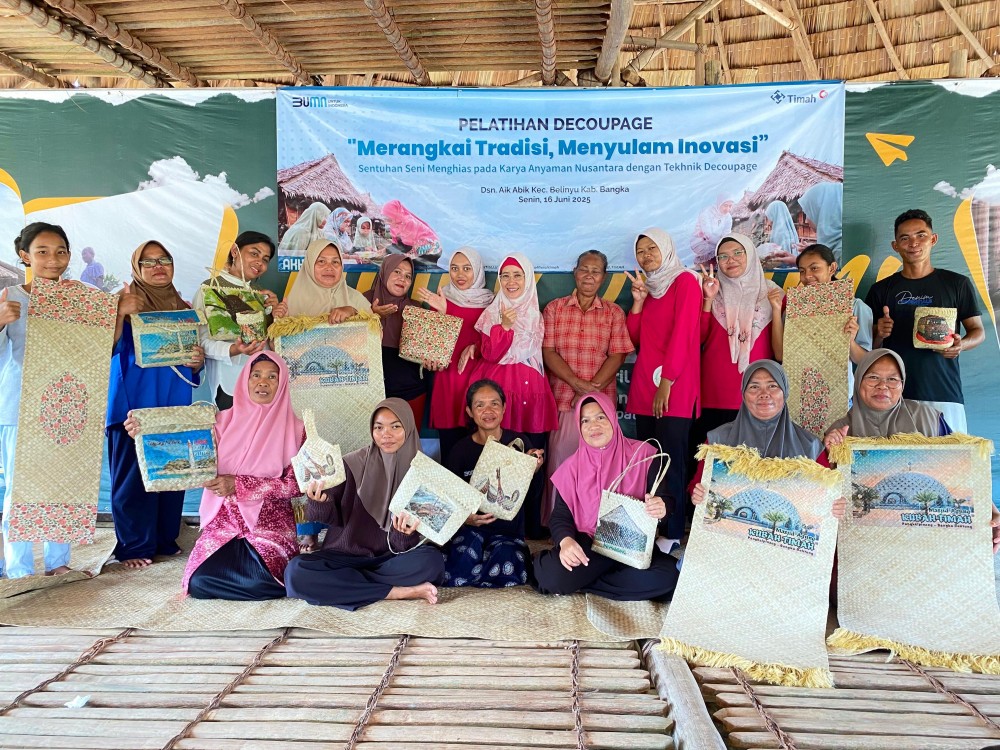
BANGKA – As part of its commitment to cultural preservation and enhancing the local indigenous economy, PT Timah held a decoupage training session themed “Weaving Tradition, Embroidering Innovation”, an artistic touch applied to Indonesian woven crafts using decoupage techniques.
The training was attended by members of the Mapur indigenous community and held in the traditional village of Gebong Memarong, Air Abik Hamlet, Gunung Muda Village, Bangka Regency, on Monday (June 16, 2025).
The session featured experienced decoupage crafts instructor Tri Sisca Febriyanti. Participants enthusiastically engaged in creating decorative pieces for woven crafts, learning decoupage techniques from the basics.
Using the decoupage method—decorating objects with patterned paper pieces that are then sealed with special adhesive—participants were guided to create high-value craft products such as woven bags and home décor items.
PT Timah’s Department Head of Corporate Communication, Anggi Siahaan, said the training was part of a community empowerment program aimed at developing local potential rooted in cultural wisdom and creativity.
“The participants consisted of youth and housewives, symbolizing the existence and harmony of the Mapur community. This program supports downstream development to enhance value-added products, while also preserving and sustaining Mapur culture,” said Anggi.
This initiative also aligns with President Prabowo's ASTA CITA program, which envisions a Golden Indonesia 2045. One key pillar of ASTA CITA is developing from villages and from the grassroots—positioning rural areas as the center of national development. The concept of desa binaan (fostered villages) is a strategic initiative aimed at making villages inclusive and sustainable growth centers.
“Through this training, we aim to encourage indigenous communities not only to preserve local culture but also to leverage it as an additional source of income. Local craft potential is immense and can be modernized without losing its traditional roots,” Anggi added.
Meanwhile, training instructor Tri Sisca—known affectionately as Teh Yiyi—said the participants were very enthusiastic, discovering a new and unique way to add value to the woven products they already make.
“We shared insights on how to enhance the selling value of their existing woven crafts using decoupage. Previously, plain items became more attractive with added patterns. We also discussed product variations and ideas that could potentially become best-sellers,” she explained.
This training is expected to inspire further innovation, helping participants increase the value of their handmade products.
“We truly appreciate what PT Timah has provided for the people of Air Abik, not only in terms of facilities and infrastructure, but also in supporting the creativity and skill development of the community. This helps them grow and think more broadly, which will have a positive impact on their livelihoods and, more broadly, the economy of Air Abik Village itself,” she concluded. (*)