PANGKALPINANG — Cual weaving is not just a piece of cloth; it represents the cultural heritage of each region. This includes the Bangka Belitung Islands Province, which is known for its Cual fabric with a wide variety of motifs.
Behind the beauty and intricacy of silk and gold thread weaving lies a story of dedication and perseverance from Cual artisans like Maslina Yazid, who continues to preserve Bangka’s Cual tradition to this day.
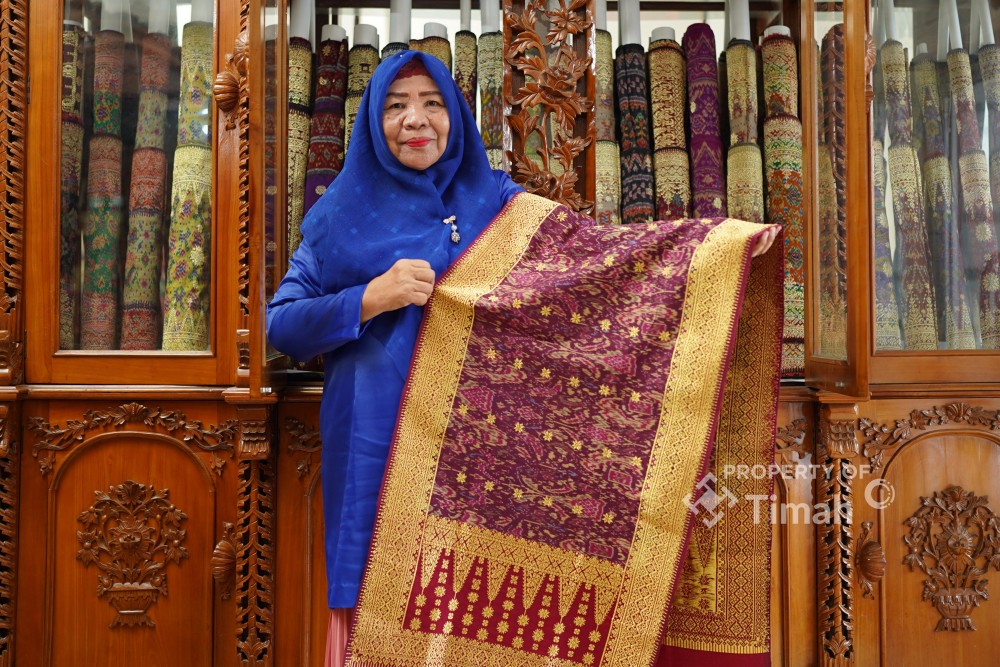
Maslina Yazid has devoted decades to her craft as a Cual weaver from Bangka. She is not alone—together with PT TIMAH Tbk, she continues to introduce, promote, and preserve Cual weaving by creating various motifs that reflect the beauty of Bangka Belitung.
She explained that Cual comes from the phrase “Celupan Awal” (First Dye), referring to the processed white or silk threads. Every Cual fabric holds philosophical meaning in its motifs and colors.
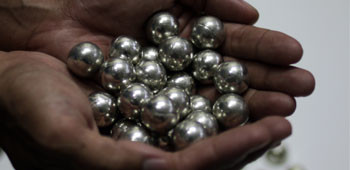
Maslina weaves Cual with motifs such as Kembang Setaman (Garden Flowers), Kembang Sepatu (Hibiscus), Kembang Melati (Jasmine), Kembang Kenanga (Ylang-ylang), and Balok Timah (Tin Block). Some of these motifs are even patented.
“Each motif has its own meaning and philosophical value. In the past, Cual was worn by royal descendants. Even the colors have meaning—for example, gold represents royalty, maroon is for the youth, purple is for widows, and black is used on funeral biers,” Maslina explained.
“The most sought-after motif is Kembang Kenanga, which has competed at the national level and received a four-star rating,” she added.
The process of making a Cual weave takes time—at least 12 days, and sometimes up to a year, depending on the complexity and motif.
It’s no wonder that Cual weaving, with its intricate craftsmanship, has a high value. Maslina produces Cual fabrics priced from Rp 3 million to hundreds of millions of rupiah. She even owns dozens of antique Cual pieces worth hundreds of millions.

To keep the Cual tradition alive, Maslina visits schools and universities to teach the art of Cual weaving. She admits that this requires considerable time and resources. Today, one of the biggest challenges in preserving Cual is the declining interest among the younger generation to become weavers.
“I visit schools and universities to share my experience and knowledge about Cual weaving. They’re interested in the process, but only a few are willing to take it up seriously. Some young people have learned to weave but stopped because of other commitments,” she said.
She expressed her appreciation to PT TIMAH Tbk, which has supported her efforts to preserve Bangka’s Cual since the 1990s. In addition to providing financial support, PT TIMAH Tbk has also helped with marketing and training so she can continue to develop her craft.
“I keep innovating to create new motifs—recently, I made the Balok Timah motif, and I was inspired to create the Pinang Mas motif as well. I am very thankful to PT TIMAH Tbk for their tremendous support of weavers like me—from funding and training to marketing and promotion,” she said.
According to her, every time she participates in exhibitions facilitated by PT TIMAH Tbk, her products always sell out. This ongoing support helps her and other artisans continue their craft.
“We’re proud to have a foster parent like PT TIMAH, who truly cares and consistently helps us preserve Bangka’s cultural heritage. To the younger generation—don’t be ashamed to become artisans. If you do it wholeheartedly, the results can be just as rewarding as any other profession. Let’s preserve our culture so it doesn’t disappear,” she urged.
Through PT TIMAH Tbk’s support, Bangka’s Cual weaving has become not only a symbol of beauty and elegance but also a testament to the collaboration between industry and community in safeguarding the nation’s cultural heritage. (*)