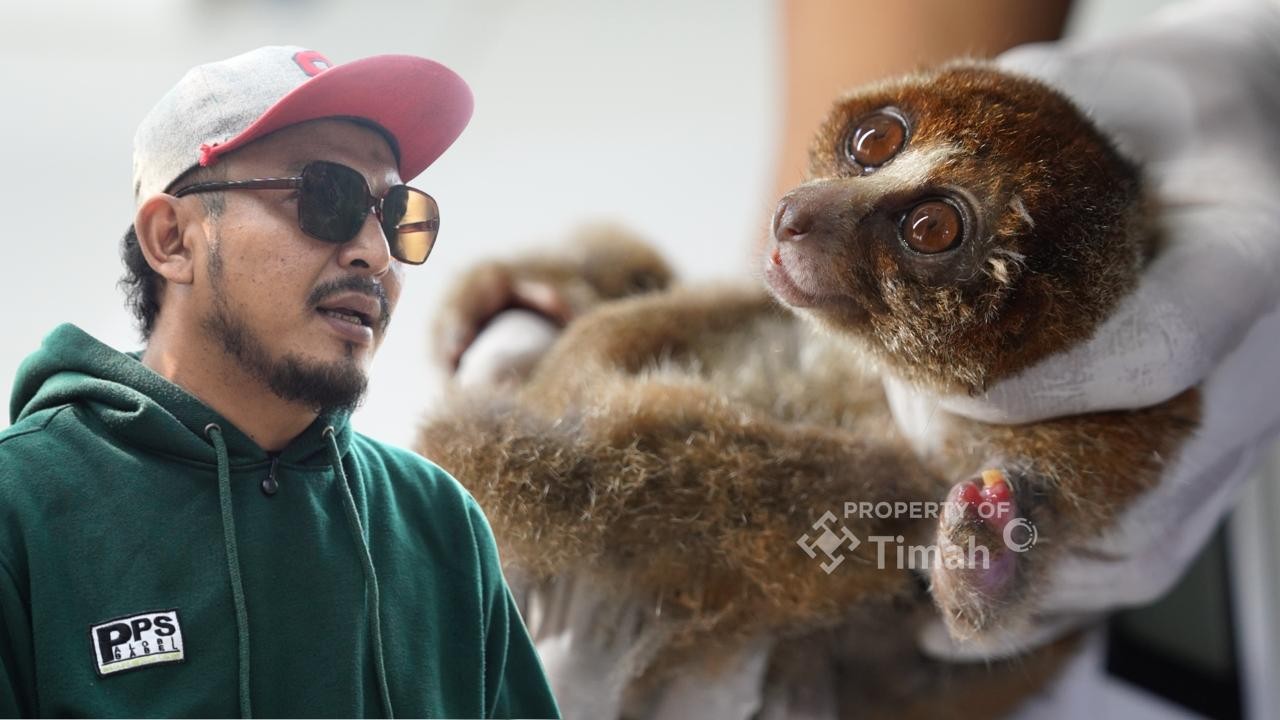
BANGKA -- Forest and land fires occurring across several areas of Bangka Belitung are threatening not only vegetation but also wildlife habitats and the safety of wild animals. This situation has prompted PT TIMAH Tbk, together with the Alobi Air Jangkang Wildlife Rescue Center (PPS), to strengthen efforts to rescue and rehabilitate affected wildlife.
Alobi Foundation Chairman Langka Sani said the increasing number of forest fires has caused wild animals to lose their natural habitats. As they attempt to escape, the animals are forced out of forest areas and often enter residential communities.
According to him, the situation is particularly concerning because Bangka Belitung is an archipelagic region where wildlife habitats are relatively limited and fragmented. When a forest area burns, animals seek safer locations, but their movement can be obstructed by roads and residential areas.
“When their habitat burns, wild animals are inevitably forced out of their natural environment. They try to escape the fire zone in search of a new habitat, but their routes are often disrupted by roads or residential areas,” Langka said.
Over the past several months, ALOBI has recorded more than 20 reports involving wildlife affected by forest and land fires. Rescued animals have included pangolins, eagles, slow lorises, tarsiers, and various bird species.
Langka said slow lorises and tarsiers are among the animals most frequently found in need of assistance. Their movement characteristics make them particularly vulnerable when fires spread through their habitats.
Tarsiers, for example, can only jump approximately three meters at a time. When the surrounding area is engulfed by fire, their movement becomes severely restricted because they depend on the remaining trees to move from one place to another.
Meanwhile, the Bangka slow loris, an endemic species of Bangka, moves more slowly. These animals travel from tree to tree by climbing or moving along branches, making them particularly vulnerable when forest areas catch fire.
“One of our endemic species is the Bangka slow loris. They move somewhat more slowly than other animals and cannot jump like tarsiers. They move from tree to tree by climbing or walking along the branches. This puts them at significant risk during a fire,” he said.
The fires can also force wildlife out of forest areas, exposing animals to additional risks as they search for safety. One case currently being handled by ALOBI involves a Bangka slow loris that suffered serious injuries after it was believed to have been electrocuted on a utility pole while attempting to move away from its habitat.
As a result of its injuries, the animal had to undergo an amputation of a body part that could no longer be saved. Its condition also means that it cannot be returned to its natural habitat.
To respond to wildlife affected by forest and land fires, ALOBI and its stakeholders have intensified monitoring efforts and responses to reports from the public. Animals that are found are evacuated for treatment and rehabilitation and are later released back into the wild if their condition allows.
Langka explained that animals that remain in good condition and have only recently been evacuated from the wild can be immediately relocated to a safer habitat. This approach helps preserve their natural instincts by preventing them from spending unnecessary time in rehabilitation.
PT TIMAH and ALOBI have collaborated on wildlife rescue efforts for more than seven years. According to Langka, through the Alobi Wildlife Rescue Center, the partnership has supported the release of more than 8,000 animals back into their natural habitats.
“We have been working with PT TIMAH through our wildlife rescue center for more than seven years. Together with PT TIMAH, we have returned more than 8,000 animals to their natural habitats,” he said.
Amid the ongoing forest and land fires, the collaboration has once again been strengthened. The Alobi Air Jangkang Wildlife Rescue Center, located within PT TIMAH’s Air Jangkang Reclamation Village area, serves as one of the facilities for sheltering and rehabilitating animals affected by the fires while waiting for environmental conditions to recover.
Langka said ALOBI will continue coordinating with PT TIMAH, the South Sumatra Natural Resources Conservation Agency (BKSDA), and other stakeholders to handle wildlife affected by the fires.
“At this time, we will focus on providing shelter for all animals affected by the fires and rehabilitating them at the Alobi Wildlife Rescue Center in PT TIMAH’s Air Jangkang Reclamation Village. We will wait for the rainy season, when we hope the ecosystem will begin to recover. After that, we will work together to return the rehabilitated animals to the wild,” he said.
He emphasized that support from various stakeholders is essential to preserving Bangka Belitung’s biodiversity, particularly its endemic species, whose survival depends heavily on the sustainability of their habitats.
Langka expressed hope that the collaboration with PT TIMAH will continue in efforts to protect Bangka Belitung’s rich biodiversity.
“PT TIMAH has made a significant contribution to wildlife rescue efforts in Bangka Belitung through its partnership with the Alobi Foundation. Hopefully, we can continue working together to preserve Bangka Belitung’s rich biodiversity in the years ahead,” he said.
According to Langka, wildlife rescue efforts are not only about responding to the impacts after a disaster occurs, but also about ensuring that wildlife continues to have safe habitats in which to live.
“To quote the principle, we are the ones who have damaged it, but we are also the ones who can restore it,” he concluded. (*)